


Time at sea
Big issues for #SmartSpecialisation
Listening to the talks today at the Smart Specialisation conference – especially the excellent keynote by @RichardALJones – here are some big issues.
What do we do about London?

And that’s just “Inner London West”!
- London accounts for about 23% of UK GDP, add in 15% ish for the rest of the South East – and we’re looking at 38% of UK GDP
- Everything we do that makes anywhere “closer” to London – high speed rail, better connections makes the problem worse – from a regional perspective.
What is a Local Industrial Strategy?
- There is a dilemma here; are we talking about national policies applied locally, or are we really going to develop policy locally that is supported nationally?
- Everything to my mind is driven ‘top down’; Industrial Strategy, sector deals etc
I’m sure you all mean well but….
Too many initiatives cutting across each other producing a confused innovation infrastructure with little eco-system thinking. How does it all fit together, what is the logic and how does the private sector fit in?
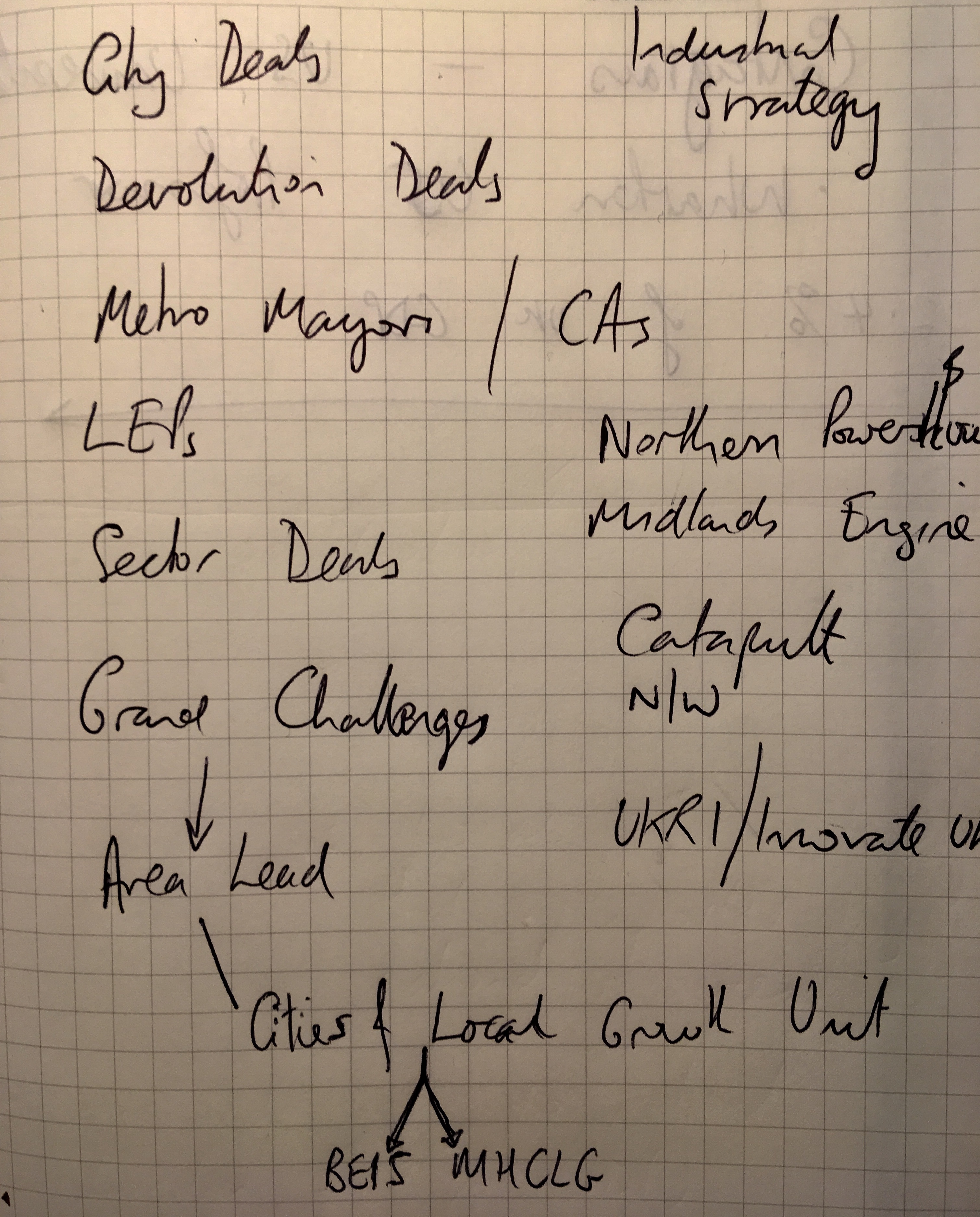
Errr…….what’s the framework, what business model is being used, how do we know what the plan is? Not clear.
Where was the Private Sector and why no discussion?
“We were going to open up for Q&A but we’re short of time so we’re not going to do that – we’ll move on” #smartspecialisation
— Brian_Condon (@brian_condon) November 29, 2018
Smart Specialisation – Liveblog

I love working on strategy – it’s all about the stories
I love working on strategy with clients especially when we can use scenario planning techniques.
It’s very exciting and engaging. It’s more about trying to understand people and what they might do rather than thinking up products and trying to work out who to sell them to. The nice thing is you can invent quite complex believable worlds with stories and thoughts about how people and businesses exist and thrive; and behaviours need to reflect the conditions in those worlds. It’s not about being right, it’s not about making predictions or being a ‘futurist’. It is about telling stories about the future.
There’s a lot of work and thought needed to create believable stories about the future and they have to be credible. It’s really interesting to see how clients react to scenario planning. If you’re used to strategy being a linear extrapolation of what you do today, then it can be a bit of a shock. The kind of business thinking that places your business at the centre of the picture and then maps the world to it is generally resistant to scenario thinking. If you have someone who thinks like this, you can use expressions like ‘strategic narrative’ and a word with ‘ology’ at the end of it. But don’t kid yourselves – they’re stories.
Scenario planning drives you to think about the world first and then think about what your options and decisions might be in each world.
In theory, scenario worlds should be extreme and quite different. In practice, if you make them too extreme, they cease to be credible. If worlds diverge too quickly then it’s difficult to develop pragmatic strategy. The invented worlds need to overlap to some extent – and it’s in the overlaps and gaps where you can look at the scope for innovation and new ideas. Ideally, you should be able to think up some elements of the strategy you will adopt that work in all the worlds you envisage – this is possible but difficult. A lot of the time though, you tend to map out options as the scenario worlds develop over time.
While it may seem fanciful, we can, though, see signals in the present of how the world might evolve in the future and we can use these as a way to generate different potential worlds. How do you find and listen to those signals and which ones do you use to develop scenario worlds? This is at the heart of the creative process of scenario planning.
You can talk to people working on new things, look at trends, look at what people do around you. For example, a few years ago on trains going up and down to London from Kent, there were increasing numbers of well dressed business men (yes men) of a clear level of seniority using iPads; these were the kinds of people who previously would open their briefcases and bring out paper copies of e-mails (no doubt printed out by their secretaries) and write replies on them. One man used to drive people mad in the mornings by tearing up these printouts in a kind of artisanal shredding process! You can speculate on why this trend was happening. Keyboards are low status or they were unable to use them so no laptop, other men were seen using iPads for business applications (remember David Cameron’s iPad government dashboard app?) so they felt able to, cost reductions and redundancies meant that there were fewer support people around, increasing environmental concerns about waste…..
Another example, in a previous job, we developed scenarios for how people might use mobile technology in their daily lives. One of the scenarios I particularly enjoyed had people walking about with small devices using little screens to control the device and communicate. No PCs, no keyboards, no wires. We got one of our designers to draw (on a big mood board) pictures of people doing this. The client hated it! At that time (and it’s a while ago!) mobile phones were just phones; Short Message Service was used by few people (aka Texting now). Another scenario was a world where the big fixed networks dominated and smart phones were a minority interest (largely due to cost). We looked at how technologies were developing that would lead to smartphones and we looked at behavioural research and consumer analysis, we did PEST analysis in the days before it became PESTLE! And we developed different worlds with different characteristics.
So how does all this relate to business strategy? Using scenarios makes business strategy simpler – if you have a story about how the world might evolve then you can look at how you might behave and the decisions you might make as a result.
The world is a complex place and strategy needs to be simple. Many people think that business strategy needs to be complicated to reflect the complexity of the world. On the contrary business strategy needs to be
1) Simple – so you can “execute” it (ie ‘do it’ – venture capitalists love the term ‘execute’ for some reason)
2) Clear – so you can communicate it to customers, colleagues and other stakeholders
3) Expressed in a model (eventually!) – so you can see if it works
So my advice is, don’t start with a business model and work up, start with your stories of the future and work down, define your strategy simply and clearly and then build a model.
Startedin – Edinburgh comes to the City of London
The event began with Frank Ross – who Convenes Edinburgh City Council’s Economic Development activities.

It’s about graduates and about computing, academic excellence, spinouts and innovative startups. There are 15 incubators in Edinburgh – Creative Exchange, Carbon Innocation, Techcube; lots of others.
There is a danger that incubators are operating in isolation – it needs to be joined up – so we’ve established the online portal Interspace – to make it easy to do business in Edinburgh.
It’s about quality of life, quality of jobs and quality of city! He pitches the city and he’s proud of it.
Amazon has been in Edinburgh for over 10 years
“We run major chunks of Amazon from Edinburgh” says Graeme Smith of Amazon

And here is what they get up to:


Skyscanner – it’s about the quality of life in Edinburgh
Richard Lennox from Skyscanner – this is how he sees it:

He’s from Carlisle. “I’ve always wanted to work in a global scale technology business”.
Why Edinburgh not London?
It’s not tangible – but it is about the quality of life in Edinburgh.
Here are my more detailed notes and liveblog in Storify

Digital Catapult Centre Yorkshire – SME meeting
We heard about the Catapult’s portfolio of services:

And also areas of focus:


The Fuse Manifesto
To Birmingham for the Fuse Manifesto. But what is Fusion?
 We had an Eclipse Break (it’s the featured image).
Cathy Garner spoke about London Fusion:

And the liveblog using Storify is here.
And some more pictures:

Bristol is Open
Bristol is a great place – and there’s always a lot going on. I to the launch of Bristol is Open and here is the liveblog:
GEEK Digital Debate
To Margate and the fabulous GEEK Festival of Games and Play!
On Thursday 19th February, I produced a Digital Debate and here is a Storify covering it:
GEEK Video Walkthrough
Here’s a video walkthrough of the Saturday afternoon sessions – it’s more than video games, adding discussions, Cosplay, Youtubers board and card games.